My Christmas gift to the Navy

An open letter to Capt. Angus Topshee, Commander of CFB Halifax:

Capt. Topshee,

I heard on the radio this morning that you have a parking problem at CFB Halifax with 7,000 employees looking to park on the base and only 3,500 spots. (See link for CBC story.)

As a public service to you, and as a concerned taxpayer and citizen of this country, I would like to help you. I also pride myself in providing common sense solutions to problems and, since it is the Christmas season, I am providing this advice to you free of charge so that you won’t have to spend any money on consultants. They can be quite costly and consultants usually just end up using a bunch of buzzwords in a report that gathers dust on a shelf.

So, without further ado, here are some suggestions to solve the parking problem at CFB Halifax. I realize that not all employees work the same shift, but there are enough of them that work similar hours that some, or all, of the following suggestions will work.

  1. Buy some lots at three locations in the city (Halifax, Dartmouth, Bedford/Sackville) or use existing DND property to create park-and-ride lots. Provide buses from these lots to CFB Halifax. Commissionaires could supervise these lots to ensure that vehicles and their contents would be safe during the work day. A survey of employees and getting their postal codes would help identify the best places to build these lots.
  2. Explore the possibility of similar lots in waterfront areas and consider using water taxis or ferries to bring navy personnel to work.
  3. Set up a system whereby employees who live near each other can carpool. Create a bulletin board or message board — online or offline — to help people find a ride.

Doing this would alleviate the parking problem and reduce traffic congestion on the peninsula and on the bridges.

I hope you find these suggestions helpful and wish you all the best in finding a fair, economical, and sensible solution to your parking problem.

Kind regards,

Ryan Van Horne

Department of Common Sense

How the ocean’s bounty is being wasted

How the ocean’s bounty is being wasted

Reading this story in The Washington Post about bluefin tuna bycatch reminds of a time when I visited Grand Manan Island in New Brunswick and saw some tuna caught in a herring weir. Whoever owned the weir wouldn’t be able to catch the tuna and sell them. The tuna would have to be destroyed — wasted — because of government regulations that require people to have a licence to land the fish.

If you ask me, it’s more of a crime to waste it. Let people land the by catch and pay a fee (based on market weight) for doing so. Although it would be a challenge to enforce, at least this way, the resource doesn’t get wasted.

The Story of Rosalie Trombley

Rosalie Trombley was the influential music director of CKLW from 1968 to 1984.

Rosalie Trombley was the influential music director of CKLW from 1968 to 1984.

Rosalie Trombley’s life is a quintessentially Canadian story.

Why? Because her modesty and desire for privacy have largely kept her story out of the limelight. Some people know about her because it’s tough to keep a story like hers in a can forever. It’s disappointing how some people get fame for doing little or nothing yet someone like Rosalie Trombley, who deserves fame, accolades, and respect, remain largely unknown.

She was a single mom of three who started working at CKLW in Windsor, Ont. Nicknamed The Girl With the Golden Ear, she demonstrated an ability to pick songs that would become hits. She started using that talent at CKLW and soon, the fourth-most listened to station in North America (yes, it trailed only radio stations in New York, Los Angeles, and Chicago) became a trend-setter.

Record company executives and musicians would visit her office on Thursdays and try to convince her to play their record. If she liked it, and played it, it became a hit. She was bold, bucked conventional wisdom, worked hard researching what her listeners wanted, and never compromised her principles.

In the male-dominated world of commercial radio, Rosalie Trombley of Leamington, Ont., became one of the most influential people on the North American music scene during her tenure as CKLW’s music director from 1968 to 1984.

With a 50,000 watt transmission tower, CKLW reached into as many as 30 states in the U.S. and wielded more influence than the CBC could ever dream of. Her unique view of music, and a willingness to play all kinds of music — including R&B and soul — recognized that music has a unifying force on people and provides people with something to share. Not only did CKLW do this without a dime of taxpayers’ money, it faced the constant badgering and red tape from the CRTC, which failed to recognize what CKLW had accomplished and could only think of rules and regulations for it to follow.

Rosalie Trombley’s story is an inspiration for women, for people who start from humble beginnings, and for people who dare to do things differently. Tony Orlando once said there should be a movie about her life. The first draft of the script has been written and it will be read tonight.

W.P. Kinsella’s guide to writing fiction

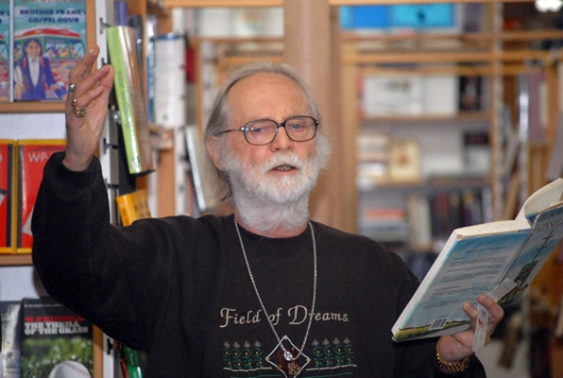
My favourite author reads from his novel Box Socials.

My favourite author reads from his novel, Box Socials.

I was thumbing through my old copy of Thrill of the Grass, a collection of short stories by W.P. Kinsella, and was struck by a sentiment that echoes something I said to a friend over coffee: fiction should entertain the reader. A corollary to this credo is that non-fiction should inform the reader and any writing that can accomplish both at the same time deserves a doff of the cap.

In the introduction to Thrill of the Grass, Kinsella writes:

“The storyteller’s craft evolves from the time when the tribe sat around the campfire in the evening and someone decided he wanted to brag about his hunting exploits. “Listen to me!” he said. “I want to tell you a story.

If that story was not colourful and entertaining, the audience very soon disappeared. As it should be. A writer’s first duty is to entertain. If something profound, symbolic, or philosophical can be slipped in, along with the entertainment, so much the better. But if the element of entertainment is not there, the writing becomes treatise, essay or autobiography, and the writer has no right to call it fiction. Ultimately, a fiction writer can be anything except boring.”

This is a great touchstone for a writer. Kinsella wrote this way and that’s perhaps why I enjoy his writing — although the subject matter helped as he often wrote about baseball.

Much fiction fails, Kinsella said, because it is too autobiographical and the lives of 90 per cent of the population are so dull, nobody could stand to read about them. The other 10 per cent live such absurd lives that they are unbelievable. The challenge is to create a perfect mix of the believable and the absurd as well as a perfect mix of reality and imagination.

Nova Scotia embraces red tide, elects Liberal government

New Nova Scotia Premier Stephen McNeil

New Nova Scotia Premier Stephen McNeil

Nova Scotia voters are strutting tonight like drunken revellers who feel like they are about to get lucky. I just hope that strut doesn’t turn into walk of shame in the next 4 years.

The Liberals have created high expectations, much like the NDP did in 2009, and they will be hard-pressed to meet them in this climate of cynicism. When only 56 per cent of voters turn out, that tells me that 44 per cent of the population thinks that there is so little difference between the parties that it doesn’t matter who gets elected. I would like to see a political party eschew the partisan barbs and start appealing to voters because they will make the right long-term decisions for the province, not short-term promises to get elected.

Can the Liberals govern differently than most governments in Nova Scotia have governed in the past? Should we expect different and will we get it?

The slate is clean. Prove yourselves.

Packed house on opening day

Photo by Devaan Ingraham / www.devaaningraham.com

Temptress! Sophia Smart (Fiona Kirkpatrick Parsons) turns on the charm and Richard Clod (Rob McIntyre) is sure it is against regulations in this scene from Department of Common Sense. Photo by Devaan Ingraham

As a playwright, your job is done before rehearsals begin and long before the curtain rises on a play. When it’s your first play, though, the work is never done. The cast of Department of Common Sense have put so much sweat and toil into this play that they deserve an audience to give them a little extra energy. That’s where my new role of producer comes into play because one of my responsibilities in that role is publicity.

We had great media coverage leading up to our first performance as part of the 23rd Atlantic Fringe Festival in Halifax, and I was delighted to see a packed house for the cast. It was a bit of a steam bath at DANSpace — one audience member quipped it would be great for hot yoga — but the cast persevered and delivered a great show that people enjoyed. It was hot, not as hot as the picture of Fiona Kirkpatrick Parsons (above), but still hot. Kudos to my friend Devaan Ingraham for this great production still.

We learned after the show that Stephen Cooke of The Chronicle Herald attended the play. I waited anxiously for the review — the first time a newspaper had reviewed my play — and I celebrated with a beer after I read this.

I think the cast, and our director Nick Jupp, should take another bow.

Department of Common Sense

DCS-production still-6

When I used to work in government, I would often joke about ridiculous ideas or policies needing to be vetted by the Department of Common Sense. No such department exists — unfortunately — except in my first play.

I took one of my favourite stories from my time in government and I turned it into a play. When I would go to parties and tell this story, people’s jaws would drop, but, as absurd as it was, they did believe it because governments and bureaucrats can do some pretty stupid things. Sometimes, it can be enough to make you want a stiff drink, like the character of Adele Courage above in a scene from the play.

I took that story and built a play around it. It’s a fictional tale of a straight-talking, tequila-sipping government minister who gets two whip-smart women on his staff to take on a persnickety bureaucrat in a battle of wills and wits.

It will make you shake your head in dismay, nod your head in understanding, or seethe with anger. It might make you do all three, but it is sure to make you laugh. We have a fabulous cast including Lianne Perry, Mark Adam, Fiona Kirkpatrick Parsons, Rob McIntyre, Neil Van Horne and Fiona MacKinnon. Nick Jupp did a great job as our director and had a hand in the development of the script when he acted as a dramaturge for me when I took part in the Theatre Arts Guild’s inaugural Playwrights’ Festival.

To learn more about my play, check out this link to the play’s blog or see our Facebook page.

It will be on stage for six shows during the 23rd Atlantic Fringe Festival. Check out the Atlantic Fringe and support local theatre. Hope you enjoy the show.

Telemarketers begone!

Despite adding my phone number to the national do-not-call-list, I’m still getting unsolicited calls from Canada. To circumvent the law, some companies have outsourced the calling to foreign firms.

I have call display, so I don’t answer unsolicited phone calls. Unfortunately, there are limitations and the feature doesn’t reveal the source of some calls from outside Nova Scotia.

Thankfully, many local and overseas telemarketers rely on computers to do the calling and this is a handy way of identifying that it is someone with whom I do not wish to speak.

“Hello,” I say when I answer the phone.

Then, there is a distinct pause while the voice-activation software informs the telemarketer that a human has answered the phone. Usually, I hang up at this point.

If I haven’t hung up, I am sometimes treated to the comedy of the telemarketer saying “hello?” as if they are wondering if anyone is there.

No, there is nobody here. Click.

If a telemarketer is efficient and somehow manages to get to the five-second mark of the call by resembling a person with whom I might want to have a conversation, then I thank my ancestors for giving me a two-word surname.

“Hello, Mr. Horne?” is often the nail in the coffin for these unwelcome intrusions on my work day.

Alexander Graham Bell gets lots of credit for inventing the telephone, but I think that without call display, a telephone is just a nuisance.

Some people are too polite to hang up on unsolicited phone calls, but not me.

I am not a misanthrope, but I do allow myself one this one indulgence and have no qualms about imitating the Grumpy Cat.

So, next time someone calls you while you’re eating supper or putting the kids to bed, embrace your inner misanthrope and end the call quickly.

Don’t give me the excuse that they’re just doing their job. We all make choices in life and anybody can choose not to be a telemarketer.

Are political attack ads the same as bullying?

Two thought-provoking columns (Dan Leger here and Chad Lucas here) and a cartoon today by Michael de Adder — all former colleagues — prompted a thought-provoking question from yet another former colleague.

Stephanie Domet, who is the host of CBC’s Mainstreet here in Halifax, sought the views of parents in Nova Scotia who have tried explaining to their kids the difference between political attack ads and bullying.

I haven’t tried to explain it to my youngest kids, but I think the difference is negligible or non-existent.

The difference as I see it is this. When you’re younger, you go to bed early and eat your vegetables because it’s the smart thing to do and your parents make you. If you have good parents, you don’t bully because they hold you accountable. Then, when you get older, you can stay up late and stop eating vegetables. Why? Because you’re a grown-up and nobody can make you do anything. You can also get away with this form of bullying — different, but in its very essence the same — because there is no one to hold you accountable. Or is there?

The electorate has to hold the people responsible for attack ads accountable. If you can’t do it directly, then make the people they’re designed to benefit pay the consequences.

I prefer my political arguments to be based on fact, not fear or hyperbole. I also like any characterizations of people that are based on quotes be done to fairly with the quote provided in context. This was not the case with the Justin Trudeau attack ads.

Conservative politicians would rightly cry foul if a journalist took one of their quotes out of context and by doing exactly that in their ads, they insult the intelligence of the electorate.

Hypocrisy, it seems, is to politicians as duct tape is to Red Green.

Rehtaeh Parsons and her family deserve the truth

I have a daughter and I cannot imagine the pain and suffering that Rehtaeh Parsons’ parents are going through right now.

I also have four teenage sons and I cannot imagine any of them participating in what happened to Rehtaeh Parsons and, if they were, I would be ashamed and turn them into police.

Four boys are alleged to have raped her in November 2011. One of them took pictures that night and shared it on Facebook. The RCMP investigated the incident and decided not to lay charges. The four boys – who were not interviewed by the Mounties until several months after the incident – were not charged with sexual assault because the police said it was a he said, she said case.

Rehtaeh Parsons was 15 at the time, so that means that the person who took her picture and distributed it online should have been charged with making and distributing child pornography. That didn’t happen either.

One of the basic tenets of Canada’s legal system is that all people should be presumed innocent until proven guilty. This, I agree with. In cases of sexual assault, the issue of consent is often the point that is argued in court and determines whether there is a conviction or an acquittal. Even if you assume that the four boys had consent, that in no way excuses what happened with the photograph.

It is illegal to create and distribute child pornography in Canada. That is what happened here and the only thing that can be disputed is who took the picture and who pressed the send button. What the police should have done was found out who owned the phone that sent the picture and on whose Facebook account the picture was posted. Given modern technology, these two things should be easy enough to do. Once charges are laid, the person – or people – responsible should have an overwhelming urge to tell police what they know and assist them in piecing together the facts.

Consent, if it existed, also doesn’t excuse the unjustified scorn Rehtaeh Parsons faced at Cole Harbour District High School and online.

That suffering ended this past weekend when, after she hanged herself in the bathroom at home, she went into a coma and was taken off life support.

Given that tragic result, even if one of my sons was questioned and not charged,  I would be taking them to the police station and making sure that they told the truth – the whole truth – about what they did and what they saw.

Unfortunately, the “My-Johnny-Can-Do-No-Wrong” Syndrome is all too prevalent and many parents fail to hold their kids accountable.

I worry about the world my daughter is growing up in. I worry that she is growing up in a province that has failed to properly investigate this incident, but I am glad that our provincial Justice Minister, Ross Landry, is looking in to this.

In the poignant words of Peter Gabriel in his song about Stephen Biko, the eyes of the world are watching now. Let’s do the right thing, Nova Scotia. Let’s find the truth and let’s have justice.